Wedding Photography
How to Look Natural in Wedding Photos When You're Camera-Shy
Feeling awkward on camera is normal and fixable. How posing and direction work, what to do with your hands, prompts that get real reactions, and why the engagement session is the rehearsal.
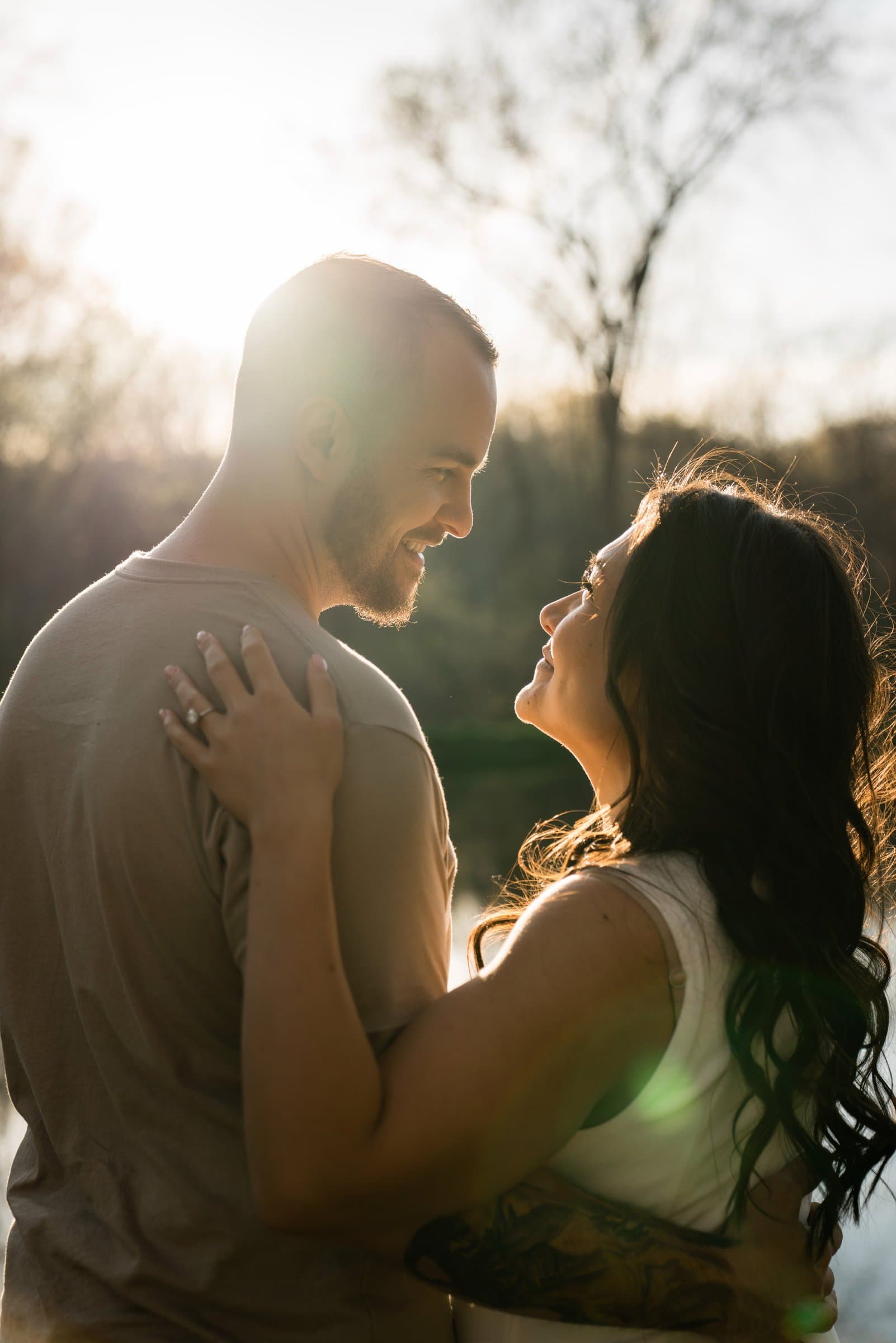
Looking natural in wedding photos when you're camera-shy comes down to direction, not talent. A good photographer places your feet, angles your body, gives your hands something to do, and then gives you a prompt, a small thing to do together, and photographs what happens. With a practice run at your engagement session, most of the awkwardness is gone by the wedding.
We pose and direct every couple we photograph, so this is how that works from your side of the camera: why photos of yourself feel strange, what we're asking you to do and why, what to do with your hands, and how the engagement session works as a rehearsal.
Why you don't like photos of yourself
Almost everyone has a version of this. Part of it is simply unfamiliar: you see your own face mostly in a mirror, which is flipped. In a 1977 study, Mita, Dermer and Knight showed people two prints of their own face, one true and one mirror-reversed. People preferred their mirror image. Their close friends preferred the true photo, the version of that face they were used to seeing.
So the photo that looks slightly off to you is often the one that looks exactly like you to everyone else. That doesn't make the nerves go away, but it helps to know part of the problem is familiarity, not your face.
The other part is not knowing what to do. That part we can fix.
How posing and direction work
Every setup we build follows the same order. It's the difference between a frame that looks relaxed and one that looks like a driver's license photo.
- Feet first. Your weight goes on your back foot, the one farther from the camera, with the front foot light and slightly turned out. That one change loosens the hips and gets rid of the stiff, squared-off stance.
- Then the angle. Bodies turn about 45 degrees to the lens instead of facing it straight on. Square to the camera is the widest anyone ever looks.
- Then the hands. Every hand gets a job before we take a frame. More on that below.
- Then a prompt. Once you're standing well, we give you something to do or say to each other, and we photograph the reaction.
All of this comes from us, out loud, one thing at a time, adjusted as we go. A couple standing well with a real laugh on their faces is what most people mean when they say a photo looks natural.
If you're comparing photographers, this is also what "posed" versus "documentary" means in practice. Our guide to wedding photography styles explains the difference and how to spot it in a portfolio.
What to do with your hands in photos
This is the single most common worry, and the answer is that hands always get a job. Some of the ones we use most:
- Flat on your partner's chest, fingers together
- Hooked into a pocket, thumb out
- On your partner's waist or the small of their back
- On the back of your partner's neck
- Adjusting something: a cuff, a watch, a jacket button, an earring
- Holding the bouquet at your natural waist, not up at your chest
- Holding a fistful of dress or skirt
- Holding hands while you walk
A slight bend in the arm always looks more relaxed than a straight arm pinned to your side. A small gap between your arm and your body helps too, and it's one of the most flattering small adjustments there is.
Adjusting something is the go-to for anyone who has no idea what to do with themselves. A groom straightening a cuff or a watch at a window looks composed in every frame, and it gives nervous hands something to do.
Prompts: the part that makes it feel less like posing
A prompt is a small instruction that creates a real reaction. We start with easy ones and move further along only as you get comfortable. The personal ones come later, if at all.
| Comfort level | What it asks for | An example |
|---|---|---|
| Easy | Movement, nothing personal | "Hold hands and walk slowly toward us, talking about dinner." |
| Soft | Closeness without kissing | "Foreheads close. Don't touch yet. Now touch." |
| Playful | Laughter | "Rock, paper, scissors. Winner gets a kiss on the cheek." |
| Personal | For couples who are already relaxed | "Whisper the thing you were laughing about in the car." |
Walking is the most reliable of all of them. Moving bodies can't hold a stiff pose, and the frames from the first and last few steps are usually the best ones. You'll walk the same stretch of path more than once, and that's normal.
The best frames often come half a second after the prompt ends, when you break and laugh at yourselves. We keep shooting through that on purpose.
Where to look
Mostly at each other. A few frames per setup look at the camera, and we'll say when. When you're looking at the lens, pushing your forehead slightly toward the camera and bringing your chin forward and a little down gives you a defined jawline. It feels strange and looks great.
If eye contact with your partner at close range makes you laugh (it does for a lot of people), their mouth, collar or ear works just as well. On camera, it reads the same.
The engagement session is the rehearsal
The engagement session included with our wedding packages is the best cure for camera nerves we know of. It runs up to two hours, and it's a rehearsal for the wedding day, with good photos as a bonus.
The first frames of any session are the stiffest, so we start with fifteen minutes of talking and warming up. By the second location, most couples have stopped thinking about the camera, and those are usually the photos people end up loving. On the wedding day, you already know our voices, how the direction works and which poses feel like you.
A lot of the nerves come from logistics too. The engagement session checklist covers what to bring, and clothes that you already feel good in help more than people expect. The engagement photo outfit guide covers that side.
One of the reviews on our site says it better than we can: "We have never had professional photos done before and were worried it was going to be an awkward experience, but they were both so easy going, it wasn't uncomfortable at all."
When one of you is more camera-shy
This is extremely common, and it helps to plan around it rather than hope it passes.
- The comfortable partner gets the active role. They lead the walk, tell the story, do the spin. The shy partner only has to listen and react, and an honest reaction is the photo.
- We stay at the easy end of the prompts longer. Walking and closeness come before anything that asks for a big expression.
- Kissing and affection are your call. Plenty of couples aren't comfortable with a lot of it on camera. Telling us at the start means every pose fits that.
- Glasses, a favorite jacket, a hand in a pocket. The small things that make you feel like yourself stay in.
On the wedding day
The wedding day has more people watching and less time, so the posing is quicker and more practiced. Couple portraits use the same steps as your engagement session. Family photos move fast from one grouping to the next; our family formals guide explains how. If you're planning a sunset portrait break, the golden hour portrait guide covers what those fifteen or twenty minutes look like.
A few things that help more than people expect:
- Eating something before portraits. Hungry, tired people look tense.
- A slow breath out before a series of frames. Shoulders drop, and faces soften.
- Letting the photographer watch for the details, like a strand of hair or a collar, so you don't have to check yourself between frames.
Frequently asked questions about being camera-shy
How do you stop looking awkward in photos?
Awkward photos usually come from standing square to the camera with nothing to do. Weight on the back foot, a slight angle, hands with a job and a simple prompt fix most of it, and a photographer who poses and directs will walk you through each step.
Do we need to practice posing before our engagement session?
Practice isn't necessary, because we direct every pose during the session, one step at a time. If you'd like to do something beforehand, looking through a few photos you like and noticing what the couples' hands and feet are doing is plenty.
Will our photographer tell us exactly how to pose?
Ours will. We pose and direct couples through every portrait: where to stand, what to do with your hands, which way to look and what comes next. The honest moments between setups end up in the gallery too.
What if we don't like kissing in photos?
That's common and easy to plan around. Foreheads close, walking, a hand on the neck and a whisper all look romantic without a kiss. Telling your photographer at the start is enough.
Why do you look weird in photos but fine in the mirror?
Mostly familiarity. You're used to your mirror image, which is flipped, and research on reversed faces found people prefer their mirror image while their friends prefer the true photo.
If you'd like to see what directed-but-relaxed looks like on real couples, our portfolio is the best place to start, and you can ask us anything about how a session would go for the two of you.