Wedding Planning
Rain on Your Wedding Day: A Photo Rain Plan for Ohio Couples
How often it rains on Ohio wedding dates, a rain backup for every photo block, which umbrellas look best, and what happens to the day when thunder rolls in.
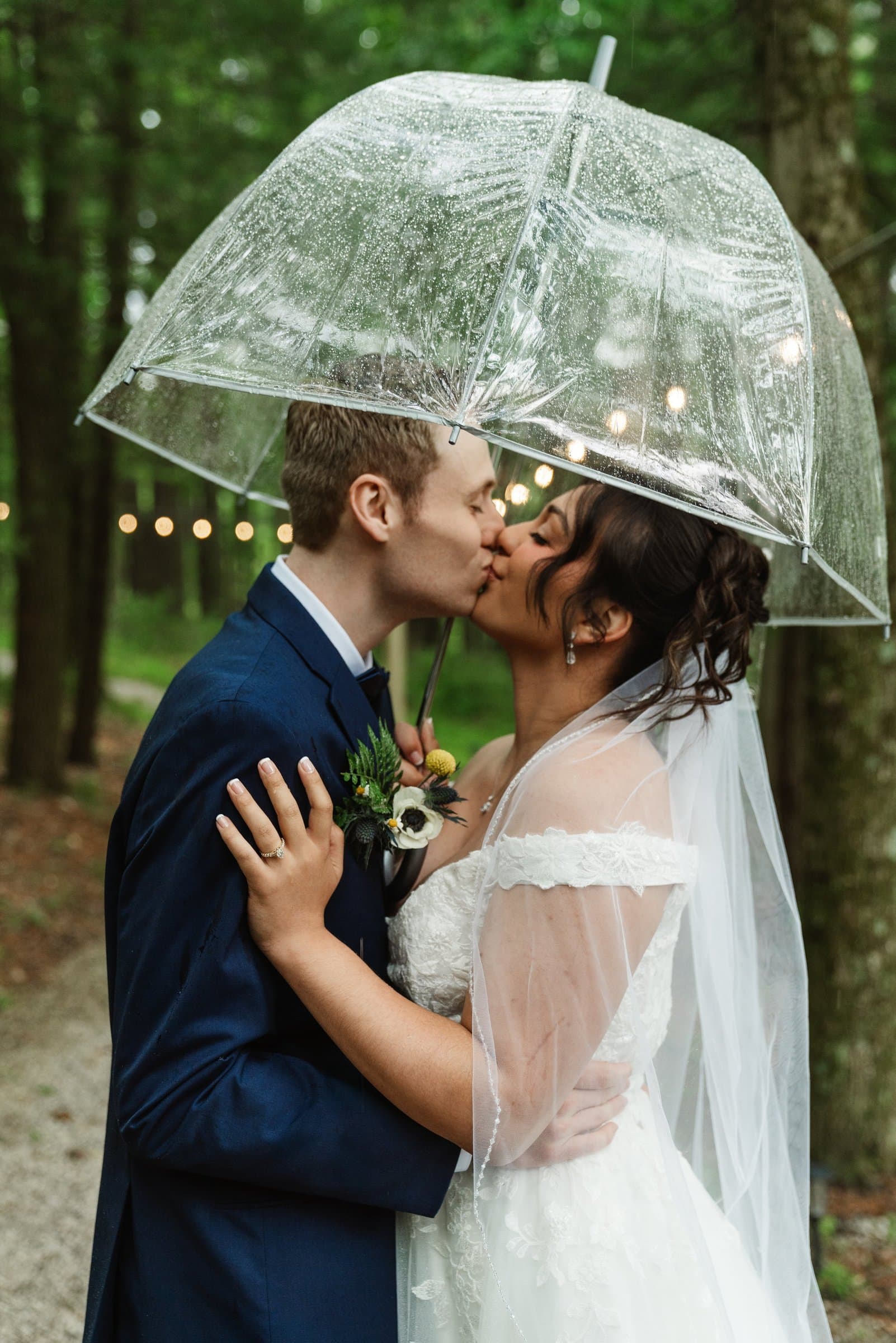
Rain on your wedding day changes where the photos happen far more than whether they happen. The couples who come out of a rainy day with great photos almost always had the same four things settled months earlier: a covered or indoor spot for every outdoor block, a time when the rain call gets made, a couple of large clear umbrellas, and an agreement that thunder moves everyone inside. This is our rain plan for wedding photos, built for Ohio weather.
How likely is rain on an Ohio wedding date?
More likely than most couples expect, and usually less dramatic than they fear. NOAA's 30-year climate normals count how many days a month get at least a hundredth of an inch of rain, which is the smallest amount that registers. Plenty of those days are one passing shower.
| Month | Norwalk: any rain | Norwalk: 0.10 in. or more | Cleveland: any rain |
|---|---|---|---|
| April | 13 days | 9 days | 15 days |
| May | 13 days | 9 days | 13 days |
| June | 12 days | 8 days | 12 days |
| July | 10 days | 7 days | 11 days |
| August | 10 days | 6 days | 10 days |
| September | 9 days | 6 days | 10 days |
| October | 11 days | 7 days | 12 days |
Averages from the NOAA U.S. Climate Normals, 1991-2020, for the Norwalk WWTP and Cleveland Hopkins Airport stations, rounded to the nearest day.
That works out to some rain on about two days in five in spring, and closer to one day in three in late summer and September. September comes out as the driest month on this measure at both stations. No month is safe enough to skip the plan.
What "40 percent chance of rain" means
The National Weather Service defines the probability of precipitation as the chance that a given spot gets at least 0.01 inches of rain during the forecast period. So a 40 percent chance on your wedding day is a 40 percent chance that your venue sees any measurable rain at all, whether that is a five-minute sprinkle at noon or a wet evening.
Timing matters too. NOAA says a five-day forecast is right about 90 percent of the time and a ten-day forecast only about half the time. The ten-day outlook two weekends before the wedding is worth a glance and not much more. The five-day forecast is where real decisions start.
The rain plan, block by block
A rain plan that says "we'll move inside" is really three or four separate questions, because every outdoor block has its own backup. This is how we would think through each one with your venue. Some venues make that far easier than others, which is one of the things we look at in our guide to Ohio wedding venues.
| Block | Rain backup | Worth confirming with the venue |
|---|---|---|
| Ceremony | Indoor room, tent, or covered pavilion | Who resets chairs and decor, and the latest time they can do it |
| First look and couple portraits | Covered porch, barn doors, big windows, or a short set under umbrellas | Which rooms are open and empty at that hour |
| Family formals | A covered spot close to the ceremony site | Room for your largest group to stand in two rows |
| Wedding party photos | Same covered spot, or umbrellas for a quick outdoor set | A clean wall or doorway with some depth behind it |
| Golden hour or sunset photos | A few minutes outside if the rain lets up, or window light indoors | Nothing, this one stays flexible |
Family formals are the block rain disrupts most. We photograph them right after the ceremony, while everyone is still gathered, so the ideal covered spot is steps from where the ceremony ends. Walking forty relatives across a wet lawn loses people. For how to keep that block moving in any weather, our family formals shot list guide covers the list and the wrangler.
For indoor portrait spots, we look for the same things in rain that we look for on a winter wedding day, and our winter wedding guide walks through what makes an indoor spot work.
When does the rain call get made?
Earlier than feels comfortable, and the venue usually sets the deadline. Moving a ceremony inside is a labor question more than a weather question: somebody has to move chairs, flowers and the arch, and sometimes flip the reception room and set it back again.
On one barn venue timeline we built, the rain plan moved the ceremony upstairs into the reception room. Because that room had to be flipped, the call had to be made by about 1:00 for a 4:00 ceremony. Tent rental companies have their own cutoffs too, often days ahead rather than hours. Both are worth asking about when you book, and worth writing into your timeline so the decision has a time attached.
A good habit for the day itself is naming one person who makes the call with the venue coordinator. It works best when that person is somebody other than the two of you.
How do rainy wedding photos actually look?
Softer than most couples picture. A thick cloud layer acts like a giant diffuser, so skin looks even, nobody squints, and colors in the dress and flowers read true. We often find overcast light easier to work in than direct afternoon sun.
Rain adds a few things sun can't:
- Reflections. Wet pavement, stone paths and puddles pick up the sky and string lights.
- Framing. A couple standing dry in an open barn door or under a porch roof, with rain falling past them, is one of our favorite rainy-day setups.
- Visible rain. Rain shows up best when there is light behind it, like a lit doorway or a flash placed behind the couple after dark. Front-lit rain mostly disappears.
- Umbrella portraits. Close, simple, and easy to direct.
We pose and direct you through a rainy set the same way we do on a dry day, just shorter and closer to cover. A few minutes outside under umbrellas, then back in. If you're up for a quick run through the rain, we'll set that up too.
If the day is gray but dry, there is a lot you can still do at sunset. Our golden hour portraits guide covers cloudy evenings and blue hour.
Which umbrellas photograph best?
Clear dome umbrellas are our first pick. Light comes straight through, so faces stay bright, and the umbrella does not throw a color onto your skin. The deep dome style that curves down around your shoulders keeps two people drier than a flat canopy does.
Black or white umbrellas look classic in wider frames. A black one makes faces under it darker, so we tend to use it tilted back or as part of the scene.
Bright colored umbrellas cast that color onto everyone underneath. A red umbrella turns faces pink. They can still work as a pop of color held off to the side.
Two large clear umbrellas for the two of you is the sweet spot, plus a few for the wedding party and whoever is walking grandparents from the car. Matching umbrellas for the whole wedding party are a nice touch and completely optional.
Protecting the dress, suit, shoes and hair
- A bustle before stepping outside. A train held up off wet ground stays clean. It helps if two people know how the bustle works, since it's hard to learn in a doorway.
- Shoes for walking, shoes for photos. Rain boots or flats between locations, then the real shoes for the frames where they show.
- Towels near the door. A couple of plain dark towels for hems, shoes and umbrella drips.
- Hair with humidity in mind. Updos and styles pinned at the base usually hold up better than loose curls. Your stylist will know what holds in damp air, so it's worth asking at the trial.
- Waterproof mascara, which is a good idea at any wedding.
- Suits and tuxes handle light rain well. Wool dries fine, and a damp shoulder rarely shows in photos.
Our wedding day emergency kit list covers everything else worth having on hand.
What happens if there's thunder or lightning?
Everyone goes inside, and nobody goes back out for at least 30 minutes after the last thunder. That is the National Weather Service lightning guidance, and it's where we draw the line on photos too.
A few specifics from the NWS that matter at weddings:
- If you can hear thunder, lightning is close enough to strike you.
- Safe shelter is a substantial building with electricity or plumbing, or an enclosed hard-topped vehicle with the windows up.
- Tents, picnic shelters, gazebos and open-sided pavilions offer no protection from lightning. A tent can be your rain plan. It is never your lightning plan.
- A severe thunderstorm watch means severe storms are possible, so it's time to stay alert. A warning means severe weather has been reported or indicated on radar, and the NWS advice is to get into a substantial building.
Most storms pass. The light right after a storm clears can be some of the best of the day, which is one reason we keep slack in the portrait blocks on a stormy forecast. If the storm hangs around, portraits move indoors and the timeline absorbs it. A sparkler exit is usually the first thing to move or swap on a wet night, since wind and rain make lighting sparklers slow.
Adjusting the timeline for rain
Rain adds small delays everywhere: umbrellas at every door, cars pulled up closer, guests slower to find their seats. Two changes cover most of it.
- About ten extra minutes around the portrait blocks, mainly for moving people between cover.
- Portraits pulled earlier when the forecast shows a dry window. If the rain is due at 5:00, a first look and couple portraits at 2:00 might stay completely dry.
That second one is a strong argument for a first look on a shaky forecast, since it moves portraits away from the one time you can't change. The full wedding day timeline guide shows how the blocks fit together. Every wedding package with us includes timeline assistance, and when the forecast looks uncertain we build the rain version of the timeline alongside the dry one.
Frequently asked questions
What do you do if it rains on your wedding day?
The day moves to the rain plan you settled with your venue: the indoor or covered ceremony site, covered spots for formals and portraits, and umbrellas for short outdoor sets. The key decision is when to make the call, which is usually set by how long the venue needs to reset the space.
Do rainy wedding photos turn out well?
Yes, usually. Overcast light is soft and flattering, and rain adds reflections and atmosphere. The photos that suffer are the ones where nobody planned a covered spot and the couple spends portrait time in a hallway with no window.
Is a tent a good rain plan?
A tent is a good rain plan for rain and a poor one for anything stronger. The National Weather Service is clear that tents offer no protection from lightning, and sidewalls, flooring and heaters are separate rental decisions with their own deadlines.
Can we still take photos outside in the rain?
Yes. A few minutes under clear umbrellas, with a covered spot a few steps away, is plenty for some of the best frames of a rainy day. Lightning is the one exception, and outdoor photos wait 30 minutes after the last thunder.
Do we need umbrellas for every guest?
Usually not, if the ceremony itself is covered. A basket of inexpensive clear umbrellas by the door covers the walk from the parking lot, and many venues keep a few on hand. The umbrellas that matter for photos are the two large ones for the two of you.
If you are planning an outdoor wedding and want a second set of eyes on the rain plan, ask us anything. We're happy to talk it through.