Wedding Photography
Church Wedding Photography Rules in Ohio: What to Ask
Church wedding photography rules are set parish by parish in Ohio. The three that come up most, why they differ, and the questions worth asking early.
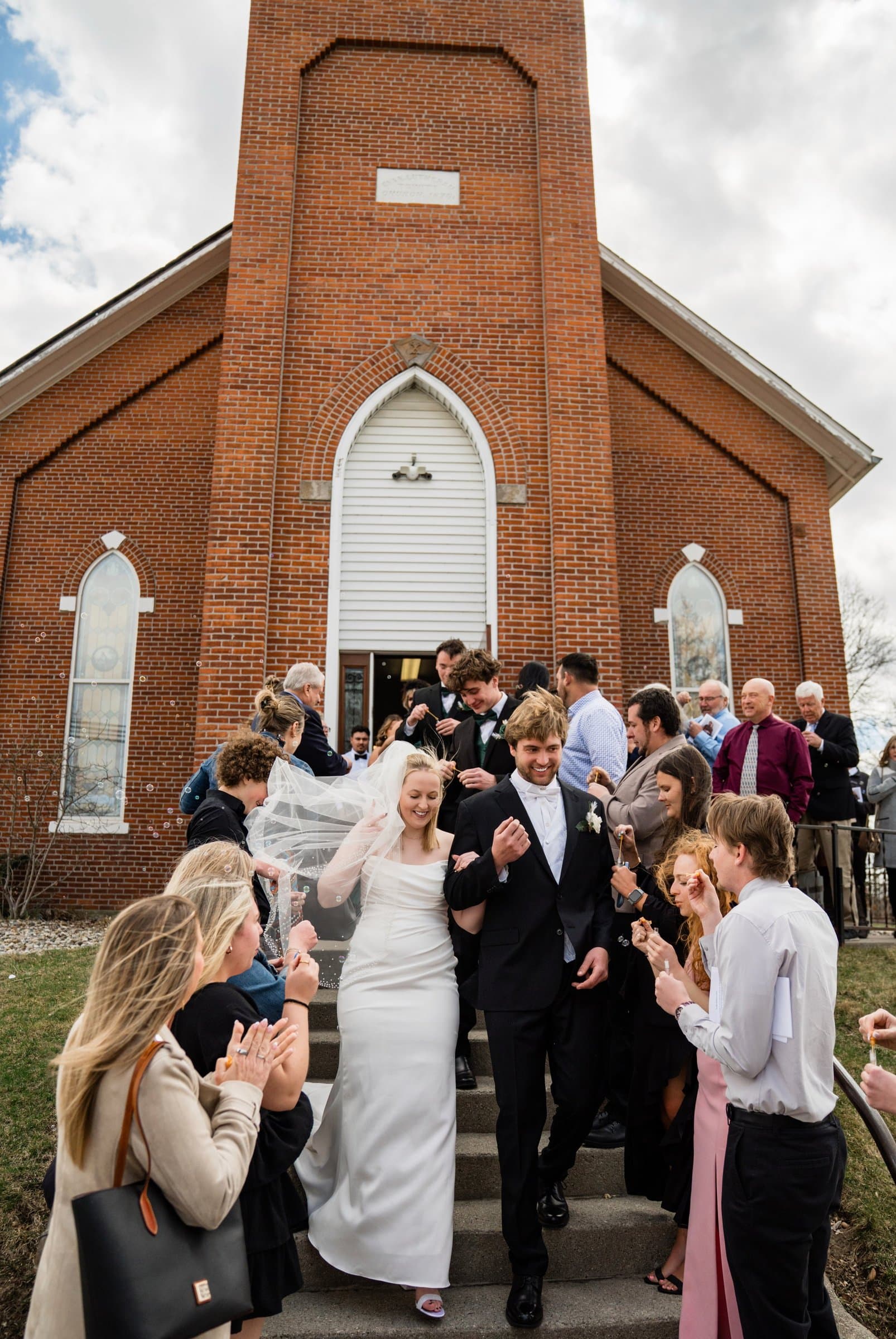
Church wedding photography rules in Ohio are set parish by parish, not by the diocese. Three come up over and over: no flash during the ceremony, a line near the altar that photographers stay behind, and a fixed window after the recessional for photos inside the church. Thirty minutes is the most common window. Every parish writes its own version.
That last part is the whole problem. A couple reads a national wedding site, sees "most churches allow photos from the back," and builds a timeline around it. Then the parish sends a one-page policy six weeks out that says all photography has to be finished by 3:45. Both things can be true, and only one of them is about your church.
Who sets the photography rules at an Ohio church?
The parish does, and often the individual officiant inside the parish.
Neither of the two dioceses that cover most of our service area publishes a photography policy. The Diocese of Toledo marriage page and the Diocese of Cleveland marriage page both point couples to their local parish. CatholicWeddingHelp, which collects diocesan and parish practice, says the same thing plainly: your parish will tell you where photographers are permitted, and parishes are free to be more lenient or more restrictive than their neighbors.
County decides which diocese you are in. Norwalk sits in Huron County and Sandusky in Erie County, and both belong to the Diocese of Toledo, along with Richland, Seneca, Ottawa and Crawford. Cleveland-area parishes are in the Diocese of Cleveland, which covers Cuyahoga, Lorain, Medina, Summit, Lake, Geauga, Wayne and Ashland. A church in Norwalk and a church in Medina are under different bishops, and that matters less than which deacon is standing at the front on your wedding day.
Protestant churches work the same way with different vocabulary: the pastor or a wedding liaison sets the policy. Plenty of Ohio churches publish nothing at all, which usually means the answer arrives out loud at the rehearsal.
The three rules that come up most
No flash during the ceremony
This is the most common restriction, and close to universal in Catholic parishes. The wording differs, and the difference is worth reading closely.
St. Catherine of Siena in Toledo goes furthest: flash is not allowed at any time during the ceremony, by the professional photographer or by any guest. St. Peter's in Mansfield carves out an exception: flash as people come down the aisle and as they leave, and no other flash or extra lighting during the wedding. St. Peter and St. Joan of Arc in Columbus and Powell allows it through the processional and then stops it cold.
We shoot ceremonies without flash by default whether or not anyone asks. It is the loudest thing a photographer can do during the quietest part of the day, and a clean frame at ISO 6400 holds up better than a flash-lit ceremony picture ever did. Fast lenses, a high ISO and a silent shutter handle a dark sanctuary. Where a no-flash policy bites is the reception lighting conversation, not the ceremony one.
The sanctuary line
In a Catholic church the sanctuary is the raised area around the altar, and most parish policies draw their line there. Some name it precisely. St. Peter and St. Joan of Arc defines it as "the area including the steps and floor levels leading up to the altar," and adds the reader's spot and the musicians to the off-limits list. St. Peter's in Mansfield puts it as the area behind the communion rail, plus the stairs.
What replaces it is a set of approved positions. Mansfield names the rear of the church, the middle of the side aisles, the spots by the pillars and the choir loft. Epiphany of the Lord in Toledo asks photographers to remain in the side aisles and be unobtrusive at all times, and says flatly that closer pictures can be posed afterward.
A few parishes go further and ask for no movement at all once the ceremony begins. Others only want quiet feet. At one Norwalk parish where we photographed a ceremony, the deacon asked us to stay off the altar entirely and work with a long lens from the back and the sides. That was his call rather than a house rule, which is why the same building is worth asking about again for the next wedding in it.
The window for photos after the ceremony
Thirty minutes is the number that shows up most. St. Catherine of Siena asks that group pictures be pre-planned and take no more than thirty minutes. Our Lady of Grace allows group photos for thirty minutes following the ceremony. Epiphany of the Lord gives an hour and warns that it is almost impossible to have both a receiving line and a picture-taking session in that time.
St. Peter's in Mansfield is the strictest published version we found: a maximum three-hour limit on use of the church, all setup pictures of the couple finished thirty minutes before the ceremony starts, and all photography completed no later than 12:45 for a morning wedding or 3:45 for an afternoon one.
Those hard stops exist for ordinary reasons. Saturday vigil Mass is usually at 4:00 or 4:30, there may be a second wedding behind yours, and someone has to reset the building.
Five published Ohio church policies, side by side
| Church | Flash during the ceremony | Where photographers may be |
|---|---|---|
| St. Catherine of Siena, Toledo | Not allowed at any time, by photographer or guests | Not between the people and the altar, not on the altar steps, platform or choir area |
| St. Peter, Mansfield | Only as people come down the aisle and as they leave | Rear of the church, middle of side aisles, by the pillars, choir loft. Not on the stairs or behind the communion rail |
| Epiphany of the Lord, Toledo | Video and non-flash pictures only | Side aisles, unobtrusive at all times |
| St. Peter and St. Joan of Arc, Columbus and Powell | None after the processional | Not in the sanctuary, the steps, or near the reader, musicians or cantor |
| Church of the Redeemer, Cincinnati (Episcopal) | At the back only as the wedding party enters | One photographer in the worship space, available light from the side aisles |
Five churches, two denominations, no two policies alike. The Cincinnati Episcopal policy is the one that would surprise most couples: it limits the worship space to a single photographer once the service starts, and it asks couples to tell guests that no flash is permitted, which is a church-mandated unplugged ceremony in all but name.
What a 30-minute window does to your wedding timeline
More than couples expect, because family formals are the block that lives in that window.
Family groupings run about two minutes each once everyone is standing where they belong. Eight groupings is roughly sixteen minutes of shooting, which fits inside thirty with room to spare. The arithmetic breaks on the changeovers: calling a group, assembling it, dismissing it, waiting on the uncle who went to find the restroom. On a long list with several family groups rotating through, a changeover runs about three minutes on top of the shooting. A twenty-grouping list with five changeovers lands closer to an hour than to thirty minutes, and no parish is holding the doors for that.
Three ways through it, and all three work:
- A short church list and a longer one at the reception venue. Grandparents, anyone elderly, anyone flying out early, and the groupings that need the altar behind them stay at the church. The rest move to the reception venue, where nobody is counting minutes.
- Splitting the formals around the ceremony. Every grouping that does not need both of you in frame can happen before the ceremony. On a long list that roughly halves what the post-ceremony window has to carry. It costs earlier call times for family.
- A first look. It moves couple portraits and wedding party photos off the church clock entirely, so the window only has to hold the family list.
Our family photo list guide has the starting list and the order that keeps it moving, and the wedding photography timeline post shows where the block sits in a full day. If your ceremony is at a church and your reception is somewhere else, the travel between them comes out of the same hour, which is also worth weighing when you pick a ceremony start time.
A receiving line and a photo session usually cannot both happen inside the window. Epiphany of the Lord says so in writing. Picking one before the day beats discovering it at the back of the church.
Why policies differ parish to parish
Because a wedding in a church is a liturgy, and how much of a production it can also be is a judgment call someone has to make.
St. Peter and St. Joan of Arc puts the reasoning in one line: a wedding is a sacred ceremony, not a photographic production. Every restriction we read flows from some version of that sentence. Where parishes differ is where they draw the balance, and that depends on the pastor, on the building, on whether the parish has had a bad experience with a photographer, and on what else is on the calendar that afternoon.
Denomination is a tendency, not a promise. Catholic parishes tend to have the most specific written policies, because the ceremony is a liturgy with defined moments and a defined space. Mainline Protestant churches, including United Church of Christ, Presbyterian and Methodist congregations, are often looser about movement during the service. Often, not always: the Cincinnati Episcopal policy above is stricter about the number of photographers in the room than any Catholic parish on this list.
The other variable is enforcement. A church that has bothered to write its rules down intends to apply them. One with nothing written is improvising through whoever is officiating, which is fine until two people in the building have different ideas. A parish in Bellevue where we photographed a ceremony sent its written photography guidelines out weeks ahead of the wedding, and they set where we could stand for the whole service. That is the good version.
What to ask your parish wedding coordinator
Short list, all answerable in one phone call or email, and worth having in writing:
- Whether the parish has a written photography policy, and whether it can be emailed.
- Whether flash is allowed at any point: processional, ring exchange, recessional, or not at all.
- Where photographers are permitted to stand during the ceremony, and whether the choir loft or balcony is open to them.
- Whether photographers may move during the service, or need to pick a position and stay in it.
- Where the line is around the altar, in the parish's own words.
- How long the church is available after the recessional, and what time everything has to be finished.
- Whether the couple can be in the church for photos before the ceremony, and by what time that has to end.
- Whether video is treated differently from stills, and whether a tripod is allowed anywhere.
- Who is officiating, and whether that officiant adds anything to the parish policy.
- Whether the photographer checks in with anyone on arrival.
Two of those do more work than the rest: the time the church has to be clear, and who is officiating. Policies get interpreted by a person, and the officiant's preference is the version that holds on the day.
How we work inside a church's rules
We ask about restrictions in the planning questionnaire, and again with the church directly when the answer is thin. Then the ceremony gets planned around whatever comes back.
A no-flash ceremony is our default anyway, so that one changes nothing. A tight position restriction changes lens choice and where each photographer sets up, and it is one of the places two photographers earn their keep: two fixed positions at opposite ends of a church cover the aisle and the faces at the altar without anyone walking around during the vows. A hard stop after the recessional changes the family list and where the rest of it happens.
The recessional is usually where the restrictions lift. Most officiants allow flash once the ceremony is over, and the walk back up the aisle and out the front door is the one part of a church wedding that is reliably loud, bright and yours. That is the frame at the top of this page.
Frequently asked questions
Can photographers use flash during a church wedding ceremony?
Often no, and it depends entirely on the parish. Some Ohio churches, like St. Catherine of Siena in Toledo, prohibit flash at any point during the ceremony for photographers and guests alike. Others allow it during the processional and recessional and nowhere in between. Most professional wedding photographers shoot ceremonies without flash regardless, so the restriction rarely changes the pictures.
Can a photographer stand at the altar during a Catholic wedding?
Usually not during the ceremony. Most published Catholic parish policies keep photographers out of the sanctuary, which typically includes the altar steps and the raised floor around the altar. Side aisles, the rear of the church and the choir loft are the positions most commonly allowed instead. Posed photos at the altar after the ceremony are usually fine.
How long do you get for photos in the church after the ceremony?
Thirty minutes is the most common published window, though some churches allow an hour and a few set a hard clock time instead. St. Peter's in Mansfield requires all photography to be finished by 3:45 for an afternoon wedding. The window has to cover family formals, so the size of your family list is the thing to check it against.
Do all Catholic churches in Ohio have the same photography rules?
No. Ohio has six Catholic dioceses and neither the Diocese of Toledo nor the Diocese of Cleveland publishes a photography policy, so the rules are written at parish level and vary between parishes in the same county. Two churches ten minutes apart can have completely different policies on flash, movement and timing.
What if our photographer has not worked at our church before?
Normal, and solvable. What matters is that the policy gets read before the wedding day rather than at the door, and that lenses and positions are planned around it. How a photographer handles a church that restricts flash and movement is a fair question at a consultation.
Before you build the timeline
The parish policy in writing, early, is the easiest thing on this list and the one that changes the shape of the afternoon.
If you are planning a church wedding in North Central or Northeast Ohio and want help fitting the photography around your parish's rules, say hello. We have worked inside these restrictions in Norwalk, Bellevue and Huron, and they are easier to plan for than to improvise around.